Showing posts with label Surgery tips. Show all posts
Showing posts with label Surgery tips. Show all posts
What kind of nose is considered as the most beautiful nose?
Labels:
Surgery tips
·


The most beautiful nose is the most harmonious nose with your face.
Because the shape of the nose is prominently different between races and individuals, its arrangement, contour of the face, structuring effect and the shape of the nose can greatly influence the face's appearance.
In general, a Westerner's nose is high and narrow in width while Asians have a flat and wide nose.
Korean's generally have an oval nose which widens coming down below the bridge.
Although one might have a high and sharp nose, we cannot consider it sophisticated if the overall face is not balanced. 'An ideal nose' can be rated according to the proportion of the nose to the face listed below:


●Starting Point: Between the eyelashes and the line of double eyelids.Generally many believe it ideal to have the bridge of the nose start at base of the double eyelids; this will make the nose look artificial for Asians so it is more natural looking to have it start at the eyelashes.

●Side profile
We consider it idealistic for a nose to lift upward at the tip of the nose for women and neat and straight for men. However, it is necessary personalize the adjustments according to the face shape and the distance between one's eyes. Recently, it has become more diversified to personalize to a person's face than following the previous standard whether this might be a straight or moderately lifted nose.

●An angle where the columella nasi (pillar of the nose) and philtrum (structure that forms the upper lip and nose) meet (nasolabial angle)
Over 90-95˚(Over 100˚ for Westerner)
An angle between the line of the nose and the forehead: 135-140˚
How to make your eyes look like shining star?
Labels:
Surgery tips
·

JW Personalized Blepharoplasty got the answer!
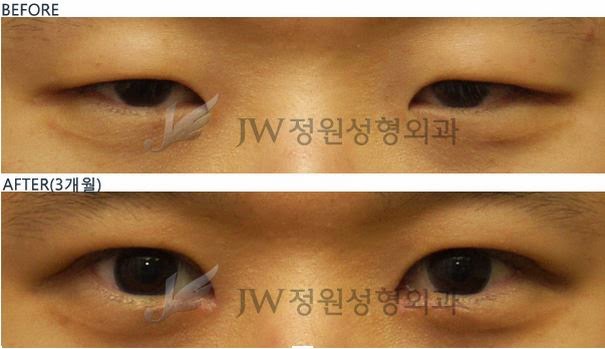
So now, lets take a look what kind of blepharoplasty procedures JW has.
- Double Eyelid Surgery
- Non-incision Ptosis Correction
- Incision Ptosis Correction
- Dual Epicanthoplasty
- Dual Lateral Canthoplasty
- Upper Eyelid Wrinkle Surgery
- Lower Eyelid Surgery
- Revision
*You can click those name of procedures if you need more information.
- Double eyelid surgery
Double eyelid surgery itself has 3 types of method which are non-incision, partial incision and incision method.
▶Non-incision method


▶Partial incision method


Partial incision is a method to remedy of the two method's shortcomings. This procedure requires an incision 5mm on the inner and outer eyelid creating the double eyelid and then stitching up the incisions. The method is recommended for those who have strong orbicularis oculi muscles or thick eyelids and their creases can become undone. The surgery is usually scar-less and the swelling period is relatively short. However, this procedure is not applicable for those who have sagging eyelids.
▶Incision method
Incision requires a cut on the line of the eyelid and removing a required amount of tissue (skin, muscle, fat, connective tissue) while connecting the dermis to the tarsi allowing the cicatrix(scar) between the two tissues to make a deep and natural double eyelid. Patients with sagging skin, thick muscles or fat layers, incision is highly recommended. The possibility of the double eyelid becoming undone is smaller than the non-incision surgery because the stitches would be tighter allowing for them to last longer. Swelling will last longer and a longer period of time is required for a more natural look.

☞Types of Double Eyelids according to shape
Infold

Outfold
This type, is commonly seen amongst Westerners can look a bit awkward and unfamiliar among Asians. For those who do not have an epicanthic fold or for those whose crease of the double eyelid starts outside of the epicanthic fold. The crease can be seen throughout the eye and this allows the eyes to look bigger.

In-Outfold
This is between an in-fold and out-folds of the eye and is suitable for those whose eyes are generally bigger than others. It can make your eyes look well-defined and attractive.
- Non-incision and Incision ptosis correction
Was the above information helpful to understand more about double eyelid surgery?
Then, lets take take a look what ptosis correction is.
▶Non-incision ptosis correction
To perform ptosis correction, the orbicularis oculi (eye opening muscle) needs to be adjusted.
Ptosis correction was only performed by an incision in the past because the orbicularis oculi lie in the deepest part of the eye and excess tissue must be remove along the way.
Ptosis correction was only performed by an incision in the past because the orbicularis oculi lie in the deepest part of the eye and excess tissue must be remove along the way.
▶Surgery Method
Because the muscles control many elements, it is important that the shape of the creases fall smoothly when the eyes are opened.


The eye-opening muscles are connected through the conjunctiva with a special suturing thread by making tiny holes under the crease of the eyelid and pulling the muscles and tarsus together.
▶Advantages of JW non-incision ptosis correction
- There is usually no scar due to the size of the incision.
- It is a fast recovery with little swelling because little or no damage is done on the tissue.
- Surgery itself is very short.
- Restoring the eyelid back to its original state is easily done by unbinding the buried suture.
▶Who are the suitable candidate for this procedure?
- People whose ptosis is not very severe
- People who want to have ptosis correction with little inconvenience to daily life
- People who want larger eyes without an incision


[Lesson 2] How to take care after the Rhinoplasty(Nose Job) by JW Plastic Surgery Korea
Labels:
Surgery tips
·
Nose Surgery (Rhinoplasty)Post-Operative Instructions
by JW Plastic Surgery Korea
by JW Plastic Surgery Korea
This information is about how to take care after the Rhinoplasty(Nose Job) from
JW Plastic Surgery Korea

- Have someone drive you home after surgery and help you at home for 1-2 days.
- Get plenty of rest after rhinoplasty.
- Take pain medication as prescribed from JW Plastic Surgery Korea after Rhinoplasty(Nose Job).
Do not take aspirin or any products containing aspirin unless approved by your surgeon. - Do not drink alcohol when taking pain medications after Rhinoplasty.
- Even when not taking pain medications, no alcohol for 3 weeks as it causes fluid retention.
- If you are taking vitamins with iron, resume these as tolerated.
- Do not smoke, as smoking delays healing and increases the risk of complications.
Activities
- Start to walk as soon as possible after the rhinoplasty,
this helps to reduce swelling and lowers the chance of blood clots. (But do not run or do any kinds of hard exercise) - Do not drive until you are no longer taking any pain medications (narcotics).
- You can Return to work in 1-2 weeks after the Rhinoplasty(Nose Job)
- Avoid strenuous activities or any activity that increases your blood pressure for 2-3 weeks.
- Avoid body contact sports, hitting or rubbing your nose, and sunburn for 2 months after the Rhinoplasty(Nose Job).
Incision Care
- Avoid exposing scars to sun for at least 12 months.
- Always use a strong sunblock, if sun exposure is unavoidable (SPF 30 or greater).
- Keep steri-strips on.
- Keep incisions clean and inspect daily for signs of infection.
- Stay in bed with your head elevated (except for going to the bathroom) for the first day.
- Cold compresses will reduce swelling.
- Do not shampoo your hair until nose splint is removed, or ask for special instructions (We shampoo your hair from JW Plastic Surgery Korea after the Rhinoplasty(Nose Job) when you come in for Treatments
- Avoid blowing your nose for 1 week after the Rhinoplasty(Nose Job).
- Be gentle when washing your face and hair or using cosmetics (No Pressures!).
- Do not use facial make-up on external incisions until advised by surgeon.
- Contact lenses can be worn as soon as you feel like it, but glasses cannot be worn until your nose is completely healed (approximately 2 months). After your nose splint is removed, tape your glasses to your forehead or prop them on your cheeks until completely healed.
What To Expect
- You may be up and about in 2 days, but it will be several weeks before you are entirely up to speed.
- Feeling depressed is normal.
- After surgery, particularly during the first 24 hours, your face will feel puffy.
- A small amount of bleeding is common during the first few days.
- A splint is applied immediately after surgery for 7 days. Nasal packs may also be used.
- Minimal postoperative pain.
- Your nose may ache and you may have a dull headache.
- Temporary swelling and bruising around eyes and nose will increase at first and peak after 2 or 3 days. Most swelling and bruising should disappear within 2 weeks. Some subtle swelling (noticeable only to you) will remain for several months.
- Healing is a slow and gradual process.
- Some numbness may be present around the operative areas.
- Black eyes and swollen nose and eyelids for 7-14 days.
- You may experience some discomfort with breathing.
- Swollen nasal tissues may cause nose to seem "stuffed up" for several weeks.
Appearance
- New nose looks better in 2-3 weeks and usually continues to improve for many months.
- Nasal tip drops to its permanent position in 3-6 months.
- Final results may not be apparent for a year or more.
Follow-Up Care
- If you have nasal packing, it will be removed after a few days.
- If nostrils are narrowed, sutures are removed in 3 days. All other sutures either dissolve or are removed within 14 days.
- Frequent follow-up visits should be scheduled.
When To Call
- If you have increased swelling or bruising.
- If swelling and redness persist after a few days.
- If you have increased redness along the incision.
- If you have severe or increased pain not relieved by medication.
- If you have any side effects to medications; such as, rash, nausea, headache, vomiting.
- If you have an oral temperature over 100.4 degrees.
- If you have any yellowish or greenish drainage from the incisions or notice a foul odor.
- If you have bleeding from the incisions that is difficult to control with light pressure.
- If you have loss of feeling or motion.
- If you have a nosebleed or any unusual symptoms.

JW Plastic Surgery Korea
JW Plastic Surgery Korea
598-6 Shinsa, Gangnam, Seoul, South Korea
English Hotline : +82-10 5768 5114/ 10 7195 5114
Kakao Talk ID : jwps / jwbeautykr
E-mail : jw_beauty@naver.com
Homepage : www.jwbeauty.net
Blog:jwbeautykorea.blogspot.com
[Lesson 1] How to take care after the Double Eyelid Surgery by JW Plastic Surgery Korea
Labels:
Surgery tips
·
On the Afternoon and Evening of Surgery
by JW Plastic Surgery Korea
• After Eyelid Surgery from JW Plastic Surgery Korea You should rest as much as possible, preferably in bed on two pillows or in a recliner. A bandage over the eyes is not needed. In the evening, you may take a bath if someone is there to help you. Avoid straining or bending over. Watching television is acceptable.
• To prevent swelling after Eyelid surgery, apply clean (not sterile) cold compresses to the eyelids as much as possible until you go to sleep. Gauze pads or a clean towel may be soaked in a basin of ice cubes and applied directly. Alternatively, a large Ziploc bag may be partially filled with ice cubes or frozen baby peas and placed over a moist gauze or towel.
.jpg)
• Pain after Eyelid surgery is usually mild. Use pain medicine you were given from JW Plastic Surgery Korea. Avoid using aspirin or ibuprofen for two days. Severe pain should be reported.
• It is normal for the eyelids to become red, swollen, and bruised after the Eyelid Surgery. A small amount of bloody fluid draining from the wound is normal for a few days. Occasionally, the eye itself may turn red and swell. Brisk bleeding not responsive to pressure should be reported.
• The eyelid creases will always look too high, too deep, overly rounded, and asymmetrical until swelling resolves and the deep tissues have a chance to soften. The eyelashes may appear to be pointed unnaturally upward.
• If you were given an antibiotic drop or ointment from JW Plastic Surgery Korea, gently apply a small amount to any stitches before going to bed, and then twice a day thereafter. If your eyes feel irritated, the antibiotic may be applied directly to the eye surface. Avoid the use of dry Q-tips on any stitches.
Beginning the Next Morning
• Swelling is usually at its maximum on the morning after surgery; bruising may increase slightly for several more days. Until stitches are removed, do not expect to see any changes in the crease.
• Discontinue the cold and begin warm compresses (gauze or a clean washcloth) for several minutes 3-4 times a day. A microwave may be used to heat a moistened washcloth (be careful not to overheat) that we gave eyepatch from JW Plastic Surgery Korea after the Eyelid Surgery
• Moderate activity may be resumed, although much bending and straining should be avoided for three days. Moderate exercise (brisk walking) may be resumed in three days. Avoid vigorous exercise (jogging) for ten days and swimming for at least two weeks. Sun exposure will not harm the surgery.
• Reading or computer work may be difficult due to swelling and some slight blurring of your vision, but such activities are not harmful to your surgery.
• Keep the incisions clean by gently cleansing with a clean washcloth or gauze. If water alone is not sufficient, a solution of 3% hydrogen peroxide diluted half and half with water may be used. If bleeding is activated, apply pressure.
• You may shower and wash your hair, but try to avoid getting soap in the incision.
Later Instructions and Information
• It is not unusual for a few of the sutures to untie or break after several days. As long as the incision remains closed, this is no cause for alarm.
• Try to limit your salt intake as this may increase swelling.
• Stitches are removed 7 to 9 days after surgery.
• After the sutures are removed, use the antibiotic that evening at bedtime and then discontinue. Warm compresses should be used at least once a day (and more if you wish) for three or four more days. Because the incision is fragile, be careful not to clean or pull on the wound for several days after the stitches have been removed.
• It is not unusual for the eyelids not to close fully during the first three weeks after surgery. During the day, the use of any over-the-counter artificial tear preparation may feel soothing.
• After five days, the light application of a concealer make-up to the upper cheek area may help to camouflage any bruising. Do not apply directly to the upper eyelids. Regular eyelid cosmetics may be resumed after 10 days. Use of an eyelid moisturizing cream may feel soothing. Do not apply Vitamin E oil. Special scar-reducing preparations (gels, strips) are of no value in double eyelid surgery.
• Most people look the worst on the third day, after which improvement begins slowly. Most bruising and swelling are gone by two to three weeks, although a small amount of swelling (20%) will remain behind for a much longer period. The crease will vary day to day and only gradually assume its approximate final position over four months or more, so try to be patient. Final healing (the last 5-10%) is a much longer process and may take several years.
• Contact lens wear may be resumed in 2 Weeks.
• The incision will turn red, slightly elevated, or bumpy in the weeks following surgery. The scar will then continue to fade and soften for a very long time.
• The incision may feel slightly tender for a few months. Itching is common. Any tight feeling or eyelash numbness will disappear over several months.
• Do not try to evaluate the success of your surgery during your early recovery
JW Plastic Surgery Korea
JW Plastic Surgery Korea
598-6 Shinsa, Gangnam, Seoul, South Korea
English Hotline : +82-10 5768 5114/ 10 7195 5114
Kakao Talk ID : jwps / jwbeautykr
E-mail : jw_beauty@naver.com
Homepage : www.jwbeauty.net
Blog:jwbeautykorea.blogspot.com
Subscribe to:
Posts (Atom)
.jpg)


.jpg)


